Running Head: Protective Effects of Serum Carotenoid Status
Funding Support: Comparing Urban and Rural Effects of Poverty on COPD (CURE COPD) study was supported by the National Institute on Minority Health and Health Disparities of the National Institutes of Health under award number by grant P50MD010431 (N.N.H.). In addition, this publication was developed under Assistance Agreement No. EPA83615001 awarded by the U.S. Environmental Protection Agency (N.N.H). It has not been formally reviewed by the EPA. The views expressed in this document are solely those of the authors and do not necessarily reflect those of the Agency. The EPA does not endorse any products or commercial services mentioned in this publication.
Date of Acceptance: June 29, 2026 | Published Online Date: July 15, 2026
Abbreviations: 8-OHdG=8-hydroxy-2'-deoxyguanosine; BMI=body mass index; Car=carotene; CASA-Q=Cough and Sputum Assessment Questionnaire; CAT=COPD Assessment Test; CCQ=Clinical COPD Questionnaire; CI=confidence interval; COPD=chronic obstructive pulmonary disease; CURE COPD=Comparing Urban and Rural Effects of Poverty on COPD; ELISA=enzyme-linked immunosorbent assays; FEV1=forced expiratory volume in 1 second; FVC=forced vital capacity; GEE=generalized estimating equation; ICS=inhaled corticosteroid; IFN-γ=interferon-gamma; IL=interleukin; IRR=incidence rate ratio; LABA=long-acting beta-2 agonist; LAMA=long-acting muscarinic antagonist; Lyc=lycopene; MRC=Medical Research Council; mMRC=modified Medical Research Council dyspnea scale; NHANES=National Health and Nutrition Examination Survey; SD=standard deviation; SGRQ=St George’s Respiratory Questionnaire; TBARS=thiobarbituric acid reactive substances; TNF-α=tumor necrosis factor-alpha
Citation: Jackson MK, Woo H, Putcha N, et al. Protective effects of serum carotenoid status on respiratory health among low-income individuals with COPD. Chronic Obstr Pulm Dis. 2026; 13(5): 352-361. doi: http://doi.org/10.15326/jcopdf.2025.0710
Online Supplemental Material: Read Online Supplemental Material (253KB)
Introduction
Chronic obstructive pulmonary disease (COPD) is a complex, progressive lung disease that continues to be a leading cause of morbidity and mortality.1 COPD also imposes a major decline in health-related quality of life, often resulting in persistent breathlessness, fatigue, and limitations in daily living.2 A key characteristic of COPD is inflammation at both the pulmonary level, including inflamed airway restriction, and as a systemic inflammatory immune response.3 Inflammation adds additional burden for those living with COPD, being associated with increased risk of mortality, exacerbations, and comorbid conditions.4,5
While smoking and air pollution are the main environmental irritants driving inflammation and COPD disease development,6 there is increasing investigation on dietary factors that may be able to modify this inflammatory profile. Carotenoids, including β-carotene, α-carotene, β-cryptoxanthin, lutein, zeaxanthin, and lycopene are anti-inflammatory compounds found in abundance in fruits and vegetables and intake can be measured in serum levels.7 These diverse pigments, spanning the red-orange-yellow spectrum, are a part of a plant’s natural defense system against photooxidation,8 spurring research for leveraging this mechanism of action. With high antioxidant potential, carotenoids have been observed in in vitro studies to be free radical scavengers, an important component for COPD prevention.9 Unfortunately, those with COPD are an at-risk population for low carotenoid status, as the National Health and Nutrition Examination Survey (NHANES) data show that those with COPD have significantly lower levels of serum carotenoids, compared to those without COPD.10 Conversely, those with higher carotenoid serum levels have been associated with lower prevalence of emphysema, chronic bronchitis, and asthma.11 However, there has been minimal investigation of the role of serum carotenoids in other dimensions of COPD, including respiratory symptoms, quality of life, and the ability to modify effects of other adverse exposures.
To fill this gap, the objective of this analysis was to investigate an at-risk population of low-income individuals with COPD to determine if serum carotenoid levels are associated with respiratory symptoms and health status, including exacerbations, as well as markers of inflammation and oxidative stress.
Methods
Study Population and Design
This is a secondary analysis using repeated measures data of participants from the Comparing Urban and Rural Effects of Poverty on COPD (CURE COPD) study who were enrolled between July 2014 and October 2018, with methods previously described.12-14 This cohort study analyzed the impact of air pollution and nutrition status on respiratory outcomes of low-income patients with COPD in the Baltimore, Maryland area. The CURE COPD study was approved by the Johns Hopkins Medical Institutional Review Board (IRB00069904), where all participants provided written informed consent. To be eligible, participants: (1) were ≥40 years old; (2) had physician-diagnosed moderate-to-severe COPD with postbronchodilator forced expiratory volume in 1 second (FEV1) to forced vital capacity (FVC) ratio<0.7 and FEV1 percentage predicted<80%; (3) were former smokers with ≥ 10 pack-year tobacco exposure; and (4) met the poverty indicator: residing in low income communities of Baltimore and the greater Baltimore-Washington metropolitan area (geographic poverty rate ≥ 10%) or ≤12 years of education (high school) or no private insurance (Medicare/Medicaid and state-funded programs accepted). Clinic and home visits were conducted at baseline, 3 months, and 6 months by trained study personnel. Blood and urine specimens were collected at each study visit and stored at -80°C until analysis. Telephone follow-up was performed monthly thereafter until 9 months.
Participant Characteristics
Demographic data of self-reported age, sex, race, annual household income, educational level, and smoking (pack years) were obtained via a baseline questionnaire. Additional clinical data related to COPD was collected at baseline.
Carotenoid Panel
Concentrations of 10 carotenoid biomarkers were measured in serum from each study visit at the Biomarker Research Institute at Harvard University (α-carotene, total β-carotene, trans-β-carotene, cis-β-carotene, β-cryptoxanthin, total lycopene, trans-lycopene, cis-lycopene, lutein, and zeaxanthin) using high performance liquid chromatography. Because lutein and zeaxanthin co-elute on the chromatogram, the 2 are grouped and provided as lutein+zeaxanthin. Internal quality control was monitored within each run with 2 identical high-level serums and 2 identical low-level serums, allowing within- and between-run variation estimates. External quality control was monitored by the standardization program for carotenoid analysis from the U.S. National Institute of Standards and Technology.
Inflammatory and Oxidative Stress Markers
Tumor necrosis factor-alpha (TNF-α), interleukin (IL)-6, IL-8, and interferon-gamma (IFN-γ) were measured in serum in a single batch using a custom multiplex assay at the University of Maryland Cytokine Core Laboratory (Luminex MAGPIX platform; Austin, Texas). Thiobarbituric acid reactive substances (BioAssay Systems; Hayward, California), 8-hydroxy-2' -deoxyguanosine (8-OHdG) (Antibody online GMBH), and 8-isoprostane (Cayman Chemical; Ann Arbor, Michigan) were measured in urine in 3 batches using enzyme-linked immunosorbent assays (ELISA) at the Johns Hopkins Institute for Clinical and Translational Research Core Laboratory and normalized by dividing the measured value by urinary creatinine level, which was also measured by ELISA (Quidel Corporation; San Diego, California).
Respiratory Symptoms, Health Status, and COPD Exacerbations
At each clinic visit, clinically relevant questionnaires were used to measure the degree of impact of different facets of COPD. The COPD Assessment Test (CAT) is scored 0–40, where higher scores indicate a higher impact of COPD on health and daily life.15,16 The St George’s Respiratory Questionnaire (SGRQ)17 measures health-related quality of life, targeting impaired health and perceived well-being in airways disease, where a higher score (0–100) indicates more limitations. The Clinical COPD questionnaire (CCQ) is a 10-item questionnaire evaluating health status in those with COPD, scored 0–6 points, with 6 being the worst.18,19 The modified Medical Research Council dyspnea scale (mMRC) scores the degree of breathlessness with exertion, where 4 is the most severe grade.20,21 The Cough and Sputum Assessment Questionnaire (CASA-Q) examines cough and sputum severity.22,23 CASA-Q variables have reverse scale such that the higher scores indicate better respiratory health.
At each clinic visit, exacerbation frequency in the prior 3 months was measured, reflecting a cumulative 9-month exacerbation history, based on participant self-report; exacerbation was categorized as severe, moderate/severe, moderate, or any exacerbation. Moderate exacerbations encompassed requiring an unscheduled doctor’s visit, antibiotic or systemic steroid use, or treatment in an urgent care facility due to COPD-related illness.12 Severe exacerbations included any COPD-related emergency department visit or hospitalization.
Statistical Analysis
Descriptive analyses were run to summarize participants’ baseline characteristics using either mean (standard deviation [SD]) or frequency (percentage) for the continuous or categorical variables respectively. Carotenoid’s summary statistics included mean (SD), median (interquartile range), and range and were based on total observations across participants and study visits. Of the 99 enrolled participants who completed the baseline visit, 98 (99%) had serum carotenoid measurements at one or more study visits; one participant without carotenoid measurements at any timepoint was excluded. Among the 98 participants, 57 (58%) provided serum carotenoid measurements at all 3 visits and 41 (42%) at 1 or 2 visits. Analyses used all available observations with complete data on required variables; missing values were not imputed.
To account for repeated observations within participants, all regression analyses were performed using generalized estimating equation (GEE) with exchangeable working correlation structure and robust standard error. To assess the association between carotenoid levels and COPD outcomes and inflammatory/oxidative stress biomarkers, GEE linear or GEE Poisson regression of continuous or exacerbation outcome (number of episodes) on carotenoid level was performed respectively, adjusted by covariates. The covariates included: (1) total cholesterol and body mass index (BMI); (2) baseline demographics (age, sex, race, educational attainment, household income), smoking pack years, comorbidity burden (number of medical conditions reported, e.g., heart disease, diabetes), and controller medication use (inhaled corticosteroids, long-acting beta agonists or long-acting muscarinic antagonists); and (3) the indicator for sampling batch for carotenoid panel. The inflammatory/oxidative stress biomarkers were log-transformed due to skewness; the parameter estimates for their association with carotenoid level were back-transformed and expressed as mean percentage changes. The primary analysis examined the total carotenoid levels, which consisted of the sum of each of the individual levels of all carotenoids.24,25 The secondary analysis examined each carotenoid individually (α-carotene, total β-carotene, trans-β-carotene, cis-β-carotene, total lycopene, trans-lycopene, cis-lycopene, lutein/zeaxanthin, β-cryptoxanthin). To check linearity assumptions and to flexibly illustrate the functional form of carotenoid with the outcomes, restricted cubic spline regressions of the outcomes were run on total carotenoid level. As a secondary analysis of an existing cohort, sample size was determined by the parent study and no a priori power calculation was performed for the present aims.
All analyses were conducted with Stata/MP 18.0 software (Stata Corp; College Station, Texas); and statistical significance criteria was set at p<0.05.
Results
Study Population
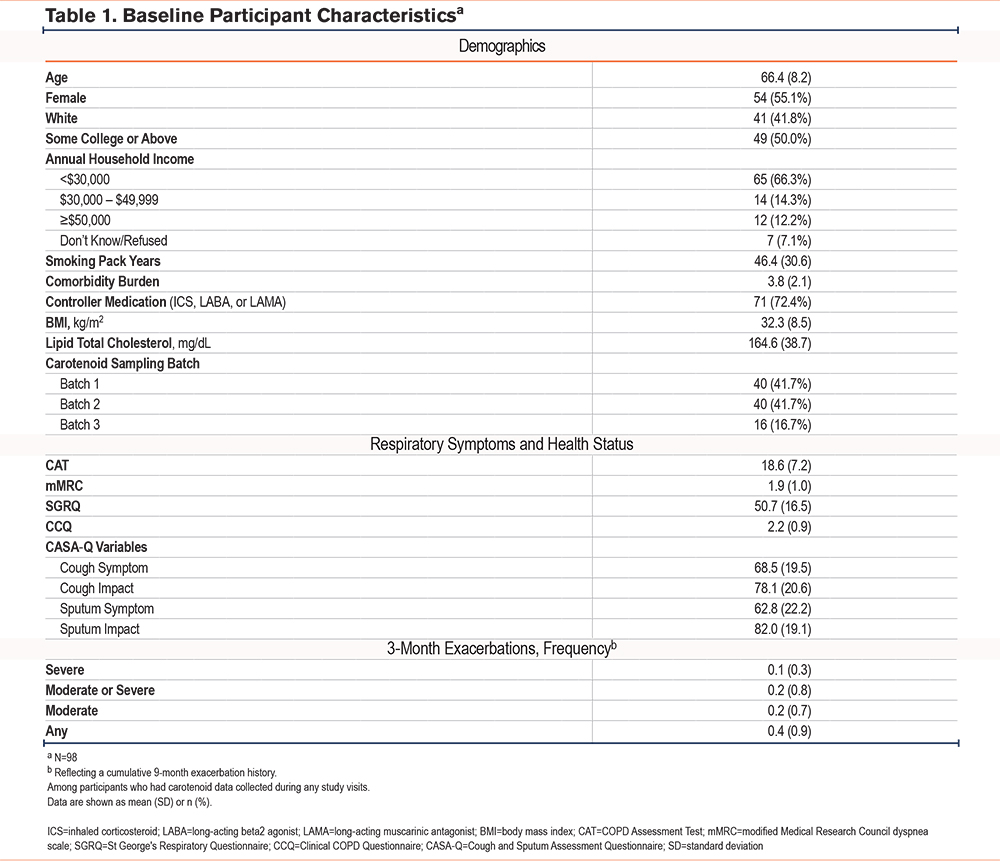
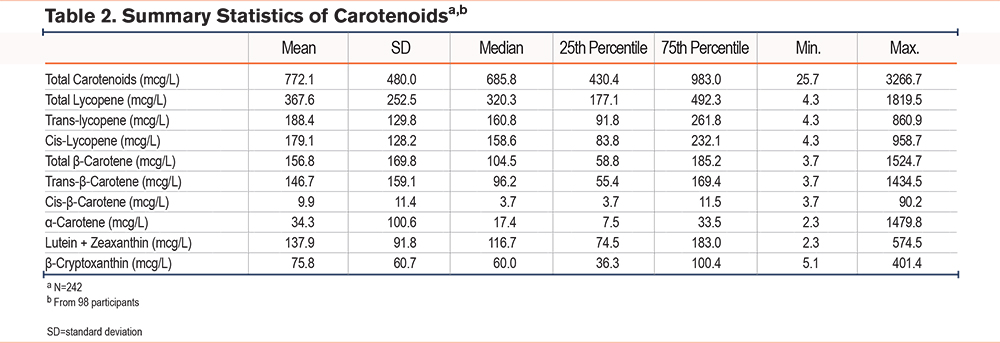
Ninety-eight participants were included in the study with a mean (SD) age of 66.4 (8.2) years old. The majority were female (55.1%, n=54) and non-White (58.2%, n=57), half completed some college or higher education (50%, n=49), and about two-thirds had a household income less than $30,000 (66.3%, n=65). On average, the participants were classified as obese (BMI: 32.3±8.5kg/m2) and had 46.4±30.6 pack years of smoking. Controller medications were used in 72.4% of the cohort and participants reported a mean comorbidity burden of 3.8±2.1 conditions (Table 1). Mean serum carotenoid levels can be found in Table 2.
Impact of Total Carotenoids on COPD Outcomes
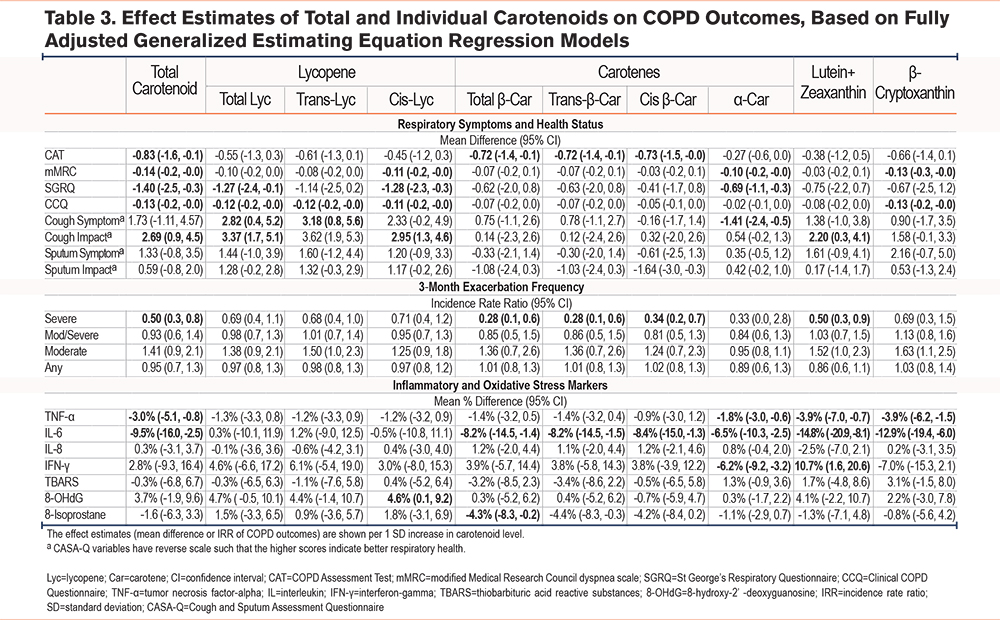
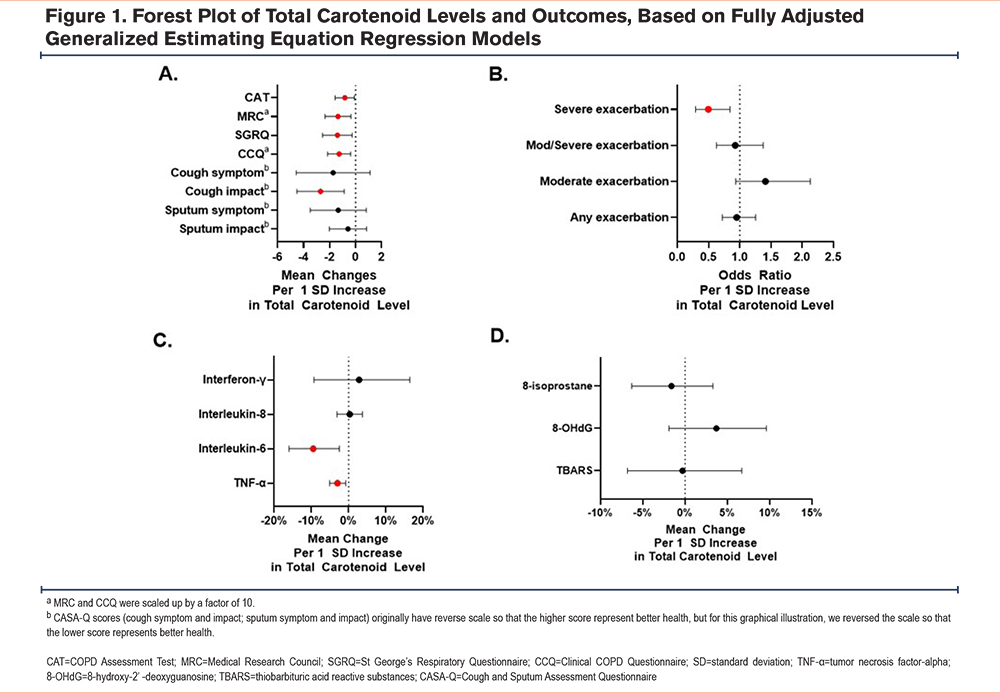
Total carotenoid levels were associated with lower (better) CAT, mMRC, SGRQ, CCQ scores, as well as a higher (better) cough impact score (Table 3, Figure 1A). For every 1 SD higher total carotenoid level, there was a 0.83 (-1.6, -0.1) point lower CAT score; 0.14 (-0.2, -0.0) point lower mMRC; 1.40 (-2.5, -0.3) point lower SGRQ score; 0.13 (-0.2, -0.0) point lower CCQ score; and 2.69 (0.9, 4.5) point higher cough impact score. Total carotenoid levels were associated with a decreased risk of severe exacerbation frequency, with a 50% lower incidence (incidence rate ratio [IRR] 0.50 [0.3, 0.8]) for every 1 SD increase in total carotenoid levels (Figure 1B). For every 1 SD higher total carotenoid level there was a 3.0% decrease (-5.1, -0.8) in TNF-α and 9.5% (-16.0, -2.5) decrease in IL-6 (Figure 1C); however, there were no significant relationships with oxidative stress markers (Figure 1D). The linearity assumptions were met in all outcomes that had significant associations with total carotenoid level (Supplemental Figure S1 in the online supplement).
Impact of Individual Carotenoids on COPD Outcomes
Lycopene
Total lycopene was associated with lower SGRQ (1.27 [-2.4, -0.1]) and CCQ (0.12 [-0.2, -0.0]) scores, with better cough symptoms (2.82 [0.4, 5.2]) and cough impact (3.37 [1.7, 5.1]) (Table 3). Lycopene subgroups had similar significant associations across COPD health status and cough symptoms, while trending toward being potentially protective of severe exacerbation incidence (not statistically significant). Cis-lycopene was associated with 8-OHdG, where for every 1 SD increase in cis-lycopene, there was a 4.6% increase in 8-OHdG (4.6% [0.1, 9.2]).
β- and α-carotene
Total β-carotene and its subgroups were associated with a better CAT score and a decreased risk of severe 3-month exacerbation frequency (Table 3). α-carotene was significantly associated with an improvement in mMRC (-0.10 [-0.2, -0.0]) and SGRQ (-0.69 [-1.1, -0.3]) scores, but worse cough symptom scores (-1.41 [-2.4, -0.5]). All carotene levels were associated with a similar impact on IL-6. Additionally, total β-carotene (-4.3% [-8.3, -0.2]) and trans-β-carotene (-4.4% [-8.3, -0.3]) were associated with a decrease in 8-isoprostane and α-carotene was associated with TNF-α (-1.8% [-3.0, -0.6]) and IFN-γ (-6.2% [-9.2, -3.2]).
Lutein+zeaxanthin and β-cryptoxanthin
Lutein+zeaxanthin was associated with an improvement of cough impact (2.20 [0.3, 4.1]) and severe 3-month exacerbation frequency (IRR 0.50 [0.3, 0.9]; Table 3), while β-cryptoxanthin was associated with mMRC (-0.13[-0.3, -0.0]) and CCQ scores (-0.13 [-0.2, -0.0]). Higher levels of lutein+zeaxanthin and β-cryptoxanthin were associated with lower inflammatory markers including TNF-α and IL-6.
Discussion
In this study, diet-derived serum carotenoids were significantly associated with COPD-related health outcomes. Importantly, while prior studies have emphasized long-term outcomes like lung function decline or mortality, our findings reveal associations with real-time outcomes, suggesting that serum carotenoids may serve as a therapeutic target for improving symptoms and quality of life in the near term. Higher total serum carotenoid levels were associated with better respiratory health status (lower CAT and CCQ scores) and lower dyspnea (mMRC) and cough impact. Total serum carotenoid levels were also associated with better respiratory-specific quality of life (SGRQ). Our study highlights the potential protective effect against severe exacerbations in those with COPD who can maintain higher carotenoid levels, given that a 1 SD increase in total carotenoid level was associated with half (IRR 0.5) the severe exacerbation rate. In COPD, treatment effects resulting in approximately 25%–30% reduction in exacerbation incidence are commonly regarded as clinically meaningful.26 As our association for severe exacerbations exceeded this threshold, it warrants further investigation into potential protective effects. Additionally, there was an association between total serum carotenoids and markers of inflammation, including IL-6 and TNF-α, supporting that carotenoids may mitigate COPD-related inflammation.
Our results add to the growing body of evidence that carotenoids impact lung-related health, encompassing dietary intake and serum levels. Studies suggest a protective effect of an overall carotenoid-rich diet on COPD risk27 and pulmonary function,28 as well as finding higher adherence to nutrient-rich plant-based diets associated with a decreased risk of emphysema development, an important clinical predictor of worse respiratory outcomes.29 Further, a 2025 meta-analysis of 21 studies demonstrated higher fruit and vegetable consumption significantly lowered the risk of COPD.30 While a recent systematic review showed an overall strong protective association of diets rich in fruits and vegetables, as well as higher β-carotene levels for COPD risk reduction, these results were not consistent, and there were individual studies with findings that differed by population.31 Bentley et al added nuance to this relationship, showing that β-carotene intake was associated with a slower rate of FEV1 decline in former smokers only, not current or never smokers.32
These studies are corroborated by studies measuring serum carotenoid levels. An analysis of the U.K. Biobank, involving over 150,000 adults with spirometry data, found positive associations for serum β-carotene levels on FVC levels, as well as dietary carotene intake.33 Yang et al reported that the highest tertile of total serum carotenoids was associated with lower prevalence of emphysema and lower risk of respiratory mortality.11 Individually, higher levels of β-cryptoxanthin were associated with lower prevalence of emphysema and chronic bronchitis, while higher lutein+zeaxanthin, α-carotene, and lycopene were associated with lower risk of respiratory mortality.11 Guenegou et al showed that serum β-carotene is also associated with attenuated lung function decline in a general population cohort and smokers with a low level of β‐carotene had the steepest decline in FEV1.34 Overall, these results, in combination with the present study, suggest that maintaining carotenoid serum levels may be important for lung health.
Carotenoids are hypothesized to improve COPD outcomes primarily through their antioxidant and anti-inflammatory activity. In vitro and in vivo models have studied these mechanisms independently35,36 and in combination.37 In our study, higher total serum carotenoid levels were associated with lower levels of IL-6 and TNF-α. This is consistent with several studies suggesting these anti-inflammatory pathways. Animal models have looked at carotenoids’ ability to decrease lung inflammation in mice with asthma, as well as their role in oxidative stress reduction in cigarette-exposed mice, including suppressing lipid peroxidation and DNA damage, and lowering inflammatory cytokines, like TNF-α.38,39 Additionally, in a human interventional trial, Al-Azzawi et al reported that supplementation with black seed oil, rich in carotenoids, led to improved lung function, reduced levels of IL-6 and TNF-α, and enhanced endogenous antioxidant defenses, increased superoxide dismutase and reduced glutathione.40 Our study also demonstrated β-carotene and its subgroups were associated with inflammation and oxidative markers. In human lung cells, β-carotene has been shown to exert antioxidant effects under both normal oxygen and hypoxic conditions, including protection against lipid peroxidation and DNA damage.36 Collectively, our findings and the literature support how carotenoids may mitigate COPD-related inflammation.
Serum carotenoid levels are directly impacted by fruit and vegetable consumption, being recognized as biological markers of fruit and vegetable consumption.41 Unfortunately, there remains no set guidance on carotenoid serum level thresholds to maintain for prevention or treatment of disease. While statistically significant, the observed effect sizes were modest relative to commonly cited minimum clinically important difference benchmarks for COPD evaluation tools.42 However, the consistency of the associations across multiple patient-reported outcome measures is a potentially meaningful signal for further investigation. Importantly, because carotenoid levels are strongly influenced by dietary intake, nutritional modification represents a promising actionable strategy through which patients can actively participate in their own care, adding to quality of life.43 As such, dietary approaches could support established COPD therapies, where therapeutic options remain limited and symptom burden remains high, enhancing disease management and promoting patient self-efficacy.44
However, systemic and individual barriers may exist in the context of diet among a low-income population. Notably, the carotenoid levels of our cohort of urban, low-income individuals with COPD are similar to nationally representative NHANES 2017–2018 carotenes levels in those with COPD.45 Yet, both our cohort’s levels and those in NHANES with COPD are significantly lower than carotenoid levels of those without COPD.10,45 The ability to maintain higher carotenoid levels through a nutrient-rich, plant-based diet may involve additional challenges pertinent to our study population such as issues of food access, including both food deserts and swamps, and food insecurity, with being able to reliably afford and source carotenoid-rich foods. Lower-income populations are at higher risk of low-quality diets lacking fruits and vegetables.46 Previous evaluations of this cohort have identified that over 26% of the population experienced food insecurity one or more times during the study and that food insecurity was associated with higher incidence rate of COPD exacerbations, and worse CAT, mMRC, and SGRQ scores, along with worse perceived stress.12 Moreover, in a NHANES analysis of diet quality trends from 1999 to 2020, there was an improvement in diet quality among the socially advantaged groups with more education, income, and health care insurance and higher food security, while low diet quality persisted or worsened with those with more social disadvantages, where non-Hispanic Black adults had the highest prevalence of poor diet quality.47 This highlights that our study population, focusing on low income adults with COPD, may have areas of built social and food environments contributing to their ability to maintain protective levels of carotenoids as a defense to COPD-related health issues. Therefore, further research is needed to investigate the role of diet interventions to improve systemic carotenoid markers as a complementary strategy for COPD management, especially within low-income populations.
This study is novel in its focus on the vulnerable, low-income urban population with COPD and the risk factors and exposures that lead to heightened risk for adverse outcomes in these individuals. Our initial findings are among the first attempts to understand how important consequences of low socioeconomic status and poor nutrient status interact to create an adverse environment in the health of individuals with COPD. However, there are limitations in our study such as the possibility of type I error, given the number of comparisons in the analysis. The fixed sample size of this secondary analysis may have limited statistical power, particularly for less frequent outcomes such as severe exacerbations. Confidence intervals should be used to evaluate the precision of effect estimates. Null findings, especially for outcomes with fewer events, may reflect insufficient power rather than true absence of association. Our study only focused on carotenoid-based antioxidants, where additional confounding from other anti-inflammatory nutrients may exist. Further research should continue to examine the benefit of multiple antioxidant sources or other anti-inflammatory diet factors, as there may be synergy in a multimodal approach.13,37 Additionally, innate factors such as polymorphism-induced differences in carotenoid metabolism are still growing areas of research48 and were not accounted for here. Air pollution is an important factor when considering the mechanistic impact of carotenoids on total inflammation burden and thus, will be explored further outside the context of this analysis. These findings may primarily reflect the experiences of low-income patients with COPD in the Baltimore, Maryland area and should be further explored in diverse communities to assess generalizability. Despite this, our study has notable strengths, including repeated measurements of serum biomarker levels that limit residual confounding by recall of dietary intake and repeated measures that reflect within person variability in dietary intake. Thus, our study demonstrates consistent results across multiple outcomes spanning disease morbidity, qualitative outcomes, and functional status and serum biomarkers.
Conclusion
Total, as well as individual serum carotenoid levels, were associated with COPD health status scores, and potentially protective against the risk of exacerbation. Further, higher carotenoid levels may reduce systemic inflammation. The findings from our study provide evidence for the role of nutrition as a complementary therapy for lung health, promoting further randomized controlled trials of specific nutrition programs targeted at the urban residents experiencing poverty to improve access to healthy foods rich in carotenoids.
Acknowledgments
Author contributions: MJ and NH were responsible for the conceptualization of the manuscript. NH was responsible for the funding acquisition. WL was in charge of the investigation and project administration. HW was responsible for the formal analysis. MJ wrote the original draft of the manuscript. HW, NP, DB, ML, KK, AF, CKH, and NH were responsible for reviewing and editing the manuscript. ML was in charge of resources. AF, CKH, and NH were in charge of methodology. CKH and NH supervised. All authors approved the final version of the manuscript submitted for publication.
Declaration of Interest
Authors have no conflicts of interest to declare.