Running Head: BGF vs Hydrofluoroalkane-134a Propellant in COPD
Funding Support: The study was funded by AstraZeneca. The funder was involved in the study design, data collection, data analysis, data interpretation, and medical writing support for preparation of the manuscript. The BGF MDI HFO, BGF MDI HFA, and placebo MDI HFA formulations were manufactured by AstraZeneca and supplied in pressurized MDIs.
Date of Acceptance: October 21, 2026 | Published Online Date: October 26, 2026
Abbreviations: AE=adverse event; ATS=American Thoracic Society; AUC=area under the curve; BGF=budesonide/glycopyrrolate/formoterol fumarate; CI=confidence interval; COPD=chronic obstructive pulmonary disease; DPI=dry powder inhaler; ERS=European Respiratory Society; FEV1=forced expiratory volume in 1 second; GWP=global warming potential; HFA-134a=hydrofluoroalkane-134a; HFO-1234ze=hydrofluoroolefin-1234ze; ICE= intercurrent event; LABA=long-acting beta2-agonist; LAMA= long-acting muscarinic antagonist; LS=least squares; NGP=next-generation propellant; pMDI=pressurized metered-dose inhaler; SABA=short-acting beta2-agonist; SAE=serious adverse event; SAMA=short-acting muscarinic antagonist; SD=standard deviation
Citation: Camiolo M, Pandya H, Jassal M, et al. Pharmacodynamic equivalence and safety of budesonide/glycopyrrolate/formoterol fumarate with a next-generation propellant versus hydrofluoroalkane-134a propellant: a randomized phase 3 study in chronic obstructive pulmonary disease. Chronic Obstr Pulm Dis. 2026; 13(6): 479-488. doi: http://doi.org/10.15326/jcopdf.2026.0793
Online Supplemental Material: Read Online Supplemental Material (165KB)
Introduction
Pressurized metered-dose inhalers (pMDIs) are widely used for delivering medications in respiratory diseases, including chronic obstructive pulmonary disease (COPD).1,2 However, propellants currently used in pMDIs, such as hydrofluoroalkane-134a (HFA-134a), are greenhouse gases with global warming potential (GWP) and, therefore, contribute to global climate change.3,4 Consequently, they are subject to a global phasedown under the Kigali Amendment to the Montreal Protocol.5 Although switching to dry powder inhalers (DPIs), which have a lower carbon footprint, may be an option to help overcome the GWP of pMDIs, some patients with reduced inspiratory flow may be unable to effectively use DPIs to obtain optimal therapeutic benefit.6-8 Therefore, transitioning pMDIs to propellants with lower GWP represents an important approach to reducing the carbon footprint of pMDIs to address environmental goals, while simultaneously safeguarding access to this essential device option.9
The near-zero GWP next generation propellant (NGP), hydrofluoroolefin-1234ze (HFO-1234ze), has a 99.9% lower GWP than HFA-134a and has been investigated as a replacement propellant for use in pMDIs.7,10 In 2025, the United Kingdom and European regulatory authorities approved a budesonide/glycopyrronium/formoterol fumarate dihydrate (BGF) pMDI reformulated with HFO-1234ze for the maintenance treatment of COPD.11,12
Within the clinical development program for HFO-1234ze, total systemic exposure to all 3 BGF constituent components was bioequivalent for BGF formulated with HFO-1234ze versus HFA-134a in healthy adults13; and adverse event (AE) rates were balanced between formulations in adults with COPD over 52 weeks follow-up as assessed by a dedicated safety study.14
Here, we report results from the first randomized double-blind study evaluating pharmacodynamic equivalence in lung function of BGF formulated with HFO-1234ze versus HFA-134a in adults with COPD. Secondary lung function parameters and safety endpoints were also assessed.
Methods
Study Design
This Phase 3, randomized, multicenter, placebo-controlled, 3-way crossover pharmacodynamic study evaluated the equivalence of BGF formulated with the pMDI propellant HFO-1234ze versus HFA-134a in adult participants with COPD (NCT06075095). This study was conducted across 91 investigational sites in 14 countries (Argentina, Bulgaria, Canada, Hungary, India, Malaysia, Mexico, the Philippines, Poland, the Republic of Korea, Thailand, Turkey, the United States, and Vietnam).
The study consisted of a screening and placebo run-in period of approximately 2 weeks before the first dose, followed by 3 consecutive treatment periods of approximately 4 weeks each, with one period dedicated to each of the 3 study interventions. A final safety follow-up was conducted via telephone approximately 1 to 2 weeks after the final study dose was administered.
Participants were randomized to receive the following treatments administered via 2 pMDI inhalations received twice daily per single dose for 4 weeks: BGF HFO-1234ze 320/18/9.6 μg (treatment A), BGF HFA-134a 320/18/9.6 μg (treatment B), and placebo HFA-134a (treatment C). Treatments were administered in 1 of 6 randomized treatment sequences (ABC, ACB, BAC, BCA, CAB, or CBA). Participants received standardized on-site training on proper inhalation technique and MDI use and cleaning at study visits 1 through 5 to ensure consistent device use throughout the study.
All study procedures were conducted in accordance with the ethical principles of the Declaration of Helsinki, the International Council for Harmonisation Good Clinical Practice guidelines, and all applicable regulatory requirements. Written informed consent was obtained from each participant before enrollment. The study protocol and informed consent forms were reviewed and approved by the institutional review board or independent ethics committee at each participating site.
Participants
Eligible participants were adults aged between 40 to 80 years with an established clinical diagnosis of COPD according to the American Thoracic Society (ATS) and European Respiratory Society (ERS) criteria.15 Participants were required to have a postbronchodilator forced expiratory volume in 1 second (FEV1) to forced vital capacity ratio of <0.70, a postbronchodilator FEV1 of ≥40% and <80% of the predicted normal value. Participants were also required to have a blood eosinophil count of <300 cells/µL to reduce the likelihood of enrolling participants at higher risk of COPD exacerbations during placebo exposure. Participants were current or former smokers with a smoking history of at least 10 cigarette pack years. Additionally, they were either receiving COPD maintenance therapy for at least 4 weeks before screening, with long-acting beta2-agonists (LABAs), inhaled corticosteroid (ICS)/LABA combinations, long-acting muscarinic antagonist (LAMA)/LABA combinations, or LAMA therapies; were receiving scheduled, or as needed, short-acting beta2-agonists (SABAs), short-acting muscarinic antagonists (SAMAs), or SABA/SAMA combinations; or were naïve to COPD therapy.
Participants were excluded if they were receiving inhaled triple-therapy, had a COPD exacerbation treated with systemic corticosteroids or antibiotics within 4 months before screening, or an exacerbation requiring hospitalization within 12 months before screening or during screening. Participants with a respiratory infection that ended within 4 weeks before screening or that began or ended during the screening and run-in period, as determined by the investigator, were also excluded.
To further minimize the risk during placebo run-in, lung function was assessed longitudinally from screening to randomization. All participants were required to demonstrate stability in FEV1 to ensure against clinical deterioration prior to study enrollment. Lung function was also assessed at monthly study visits with protocol mandated, in-clinic assessments for exacerbation based on decrease from baseline. Throughout the study, including the placebo run-in and treatment periods, all participants were provided with rescue SABA medication. Participants also completed a daily electronic diary to record COPD symptoms, rescue medication use, and the study treatment compliance. Predefined eDiary alerts notified investigators of potential clinical deterioration, allowing participants to be monitored closely and investigators to intervene as clinically appropriate.
Endpoints and Assessments
The primary objectives of this study were to assess the equivalence of BGF HFO-1234ze relative to BGF HFA-134a on measures of lung function and to establish assay sensitivity (confirmation that the study design was capable of detecting a treatment effect) by demonstrating superiority of BGF HFA-134a relative to placebo HFA-134a on lung function. An exploratory objective assessing the superiority of BGF HFO-1234ze versus placebo HFA-134a on lung function, both pre and postdose, was also evaluated. The primary and secondary lung function endpoints used to assess the primary and exploratory objective were change from baseline FEV1 area under the curve from 0 to 4 hours (AUC0–4h) at Day 29, and morning predose trough FEV1 at Day 29, respectively. An additional exploratory endpoint of time to onset of action was also assessed and is presented by each treatment separately. Time to onset was defined as the first postdose time point at which the mean change from baseline in FEV1 exceeds 100 mL on Day 1 of Treatment Period 1.
The effects of study intervention on lung function were assessed via spirometry measurements of FEV1 (and obtained according to the 2019 ATS/ERS standards)16 at all site visits using a spirometer that meets or exceeds ATS/ERS joint recommendations.17 Predose spirometry was performed at 60 ± 10 minutes and 30 ± 10 minutes prior to treatment. Postdose spirometry was performed at 5 ± 4 minutes, 15 ± 5 minutes, and 30 ±5 minutes, followed by assessments at 1, 2, and 4 hours (each timepoint ± 10 minutes). Pre and postdose spirometry was performed at the randomization visit and on Day 29 of each treatment period. To ensure consistency across periods, Day 29 spirometry assessments for all 3 treatment periods were scheduled to begin at approximately the same time of day (± 1 hour) as the baseline spirometry assessment, which occurred 60 minutes before morning dosing and ~12 hours after the dose taken the evening before. Calculated predicted spirometry results were obtained using the Global Lung Initiative equations.18
Safety and tolerability endpoints assessed included AEs and vital signs (systolic and diastolic blood pressure, pulse rate). AEs were recorded at each study visit throughout the screening and treatment periods and were reported by preferred terms and system organ class using Medical Dictionary for Regulatory Activities version 28.0. Patient-reported outcomes including data on symptom worsening and use of rescue SABAs and study interventions were also recorded.
Statistical Analyses
Efficacy and safety analyses were conducted based on the actual study intervention that the participants received. The randomized set included all participants assigned to a study intervention at randomization. The analysis set for confirming assay sensitivity included all randomized participants who completed the BGF HFA-134a and placebo HFA-134a treatment periods and was made up of the following 2 subgroups: those who had at least 1 postdose FEV1 measurement on Day 29 comprised the analysis set for assay sensitivity for FEV1 AUC0-4h analysis; those who had at least 1 prior dose (60-minute or 30-minute predose) FEV1 measurement on Day 29 comprised the analysis set for assay sensitivity for the trough FEV1 analysis. The analysis set for evaluating equivalence consisted of all randomized participants who completed the BGF HFA-134a and BGF HFO-1234ze treatment periods and was made up of the following 2 subgroups: those who had at least 1 postdose FEV1 measurement on Day 29 comprised the analysis set for equivalence for the Day 29 FEV1 AUC0-4h analysis; those who had at least 1 trough FEV1 measurement on Day 29 for the trough FEV1 analysis. Descriptive analysis was used for exploratory endpoint of onset of action. The safety analysis set included all randomized participants who received at least 1 dose of any study treatment. The safety analysis set was used to analyze disposition, demographics, onset of action, and safety.
For confirmation of the effect of BGF on lung function (i.e., to establish assay sensitivity), BGF HFA-134a was compared with placebo HFA-134a for change from baseline in FEV1 AUC0-4h and trough FEV1 at Day 29 using the same linear mixed model as for evaluating equivalence as described below. Superiority of BGF HFA-134a relative to placebo HFA-134a, and thus assay sensitivity, was established if the 2-sided p-value for the estimated mean treatment difference was < 0.05. This approach was also used to evaluate the superiority of BGF HFO-1234ze relative to placebo HFA-134a. To evaluate equivalence between BGF HFO-1234ze and BGF HFA-134a, change from baseline in FEV1 AUC0–4h at Day 29 and change from baseline in trough FEV1 at Day 29 were analyzed using a linear mixed model. For both endpoints, baseline was from spirometry performed on Day 1 of Treatment Period 1, as the study employed an active medication washout following Day 29 lung function assessments in treatment periods 1 and 2. The model adjusted for treatment, baseline FEV1, and treatment period as fixed effects, with participant as a random effect. Equivalence was concluded if the 2-sided 90% Fieller’s confidence intervals (CIs) for the ratio of BGF HFO-1234ze to BGF HFA-134a were within 0.80 to 1.25 for the primary endpoint and within 0.70 to 1.43 for the secondary endpoint. The primary estimand (a precise definition of treatment effect) used a principal stratum strategy, excluding participants with intercurrent events (ICEs) such as noncompliance, use of prohibited medication, discontinuation of study intervention, or protocol deviations impacting lung function; the supplementary estimand applied a hybrid strategy, using a treatment policy approach for ICEs other than treatment discontinuation and a principal stratum approach for treatment discontinuation.
Sample size calculations were based on change from baseline in the morning predose trough FEV1 on Day 29. A sample size of 216 participants was estimated to provide 90% power at a 5.0% significance level when using equivalence limits of 0.70 to 1.43. Allowing for an anticipated dropout rate of 20% and to account for other ICEs impacting the primary analysis, up to 300 participants were planned for randomization to ensure that an adequate number would complete all 3 treatment periods.
Results
Participant Disposition and Demographics
Participant disposition is summarized in Figure S1 in the online supplement. Treatment period completion rates were 96.8% of participants for the BGF HFO-1234ze group, 94.4% of participants for the BGF HFA-134a group, and 95.7% of participants for the placebo HFA-134a treatment group. Discontinuation rates were similar between treatment periods (3.2%, BGF HFO-1234ze; 5.6%, BGF HFA-134a; 4.3%, placebo HFA-134a). The most common reason for treatment discontinuation was due to AEs and was similar across BGF MDI HFO-1234ze (2.5%), BGF MDI HFA-134a (3.5%), and placebo MDI HFA-134a (2.5%) treatments.
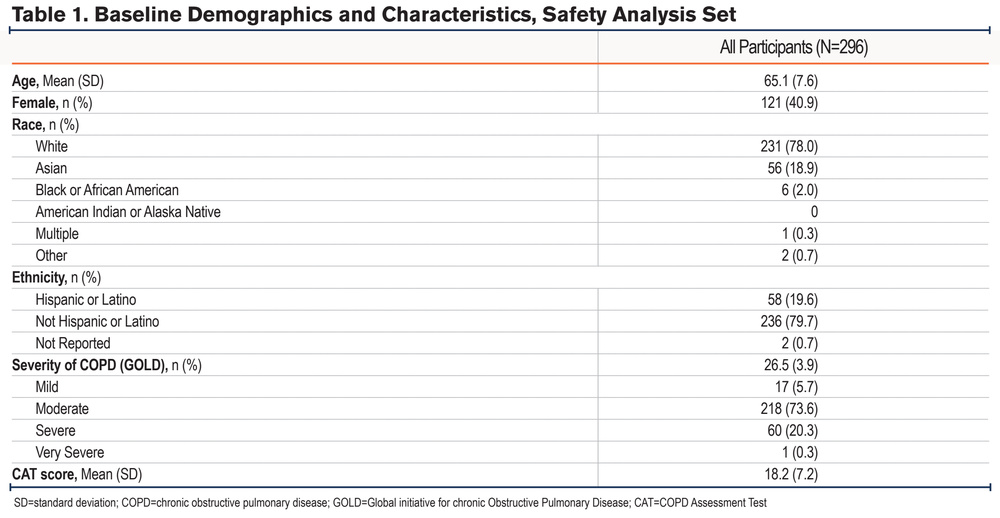
Key demographic and baseline disease characteristics are presented in Table 1. Overall, demographics and COPD disease severity were well balanced across treatment sequences and were consistent with the characteristics of the target population of patients with COPD. Prior to Visit 1, participants were receiving a range of maintenance COPD therapies, most commonly ICS/LABA (39.2%) and LAMA/LABA (24.7%) maintenance regimens; 19.6% of participants were receiving only as needed PRN SABA and/or SAMA therapy, and 6.4% were not receiving COPD therapy.
Superiority of BGF HFA-134a Versus Placebo HFA-134a (Confirmation of Effect of BGF on Lung Function), and BGF HFO-1234ze Versus Placebo HFA-134a
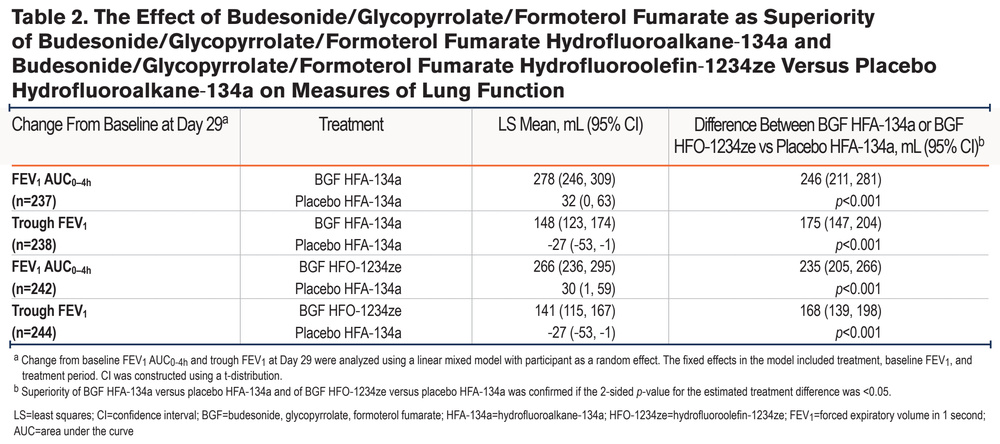
For the primary estimand, superiority and thus assay sensitivity was confirmed when comparing BGF HFA-134a with placebo HFA-134a, with significant improvements observed in change from baseline in least squares mean postdose FEV1 AUC0‑4h and in morning predose trough through FEV1 at Day 29 (p-values less than 0.001 for both endpoints [Table 2]). Superiority of BGF HFO-1234ze versus placebo HFA-134a were similarly demonstrated for both endpoints. Results using the supplementary (treatment policy) estimand were consistent with these findings.
Pharmacodynamic Equivalence of BGF HFO-1234ze Versus BGF HFA-134a
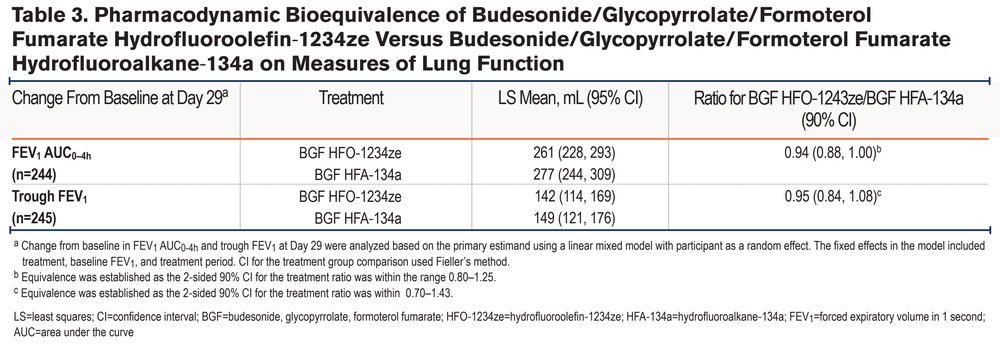
Changes from baseline in postdose FEV1 AUC0-4h and morning predose trough FEV1 at Day 29 demonstrated pharmacodynamic equivalence between BGF HFO-1234ze and BGF HFA‑134a. Using the primary estimand, the ratios for BGF HFO-1234ze versus BGF HFA‑134a were 0.94 (90% CI: 0.88 to 1.00) for FEV1 AUC0-4h and 0.95 (90% CI: 0.84 to 1.08) for trough FEV1 (Table 3). Equivalence criteria were also met for both lung function endpoints using the supplementary (treatment policy) estimand.
Time to Onset of Action
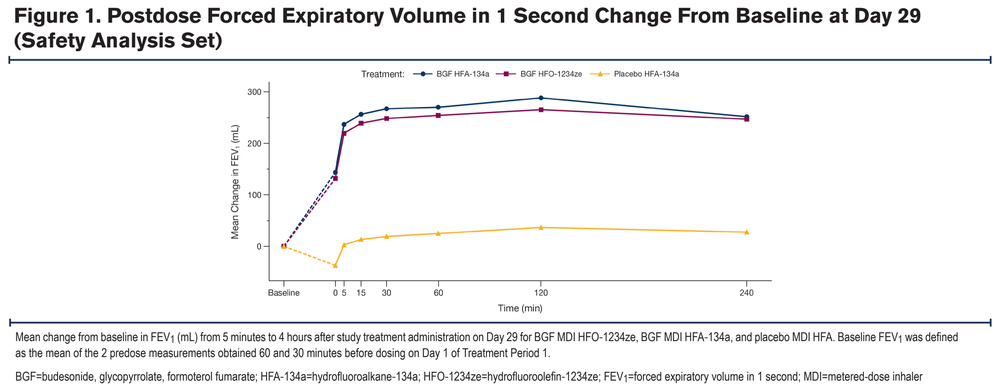
For both BGF formulations, the mean change from baseline was greater than 100mL at the 5‑minute assessment. For BGF HFO-1234ze, the mean change from baseline at the 5-minute timepoint was 144.4 mL (standard deviation [SD] 107.2), with continued improvements observed through 240 minutes. Similarly, for BGF HFA-134a, the mean change from baseline at the 5-minute timepoint was 111.8 mL (SD 135.2), with sustained increases thereafter through 240 minutes. Change from baseline FEV1 up to 240 minutes postdose at Day 29 is shown in Figure 1.
Safety and Tolerability
Overall, AEs were balanced across treatment periods, and no new safety findings were identified with BGF HFO-1234ze (Table 4). The proportions of participants experiencing AEs, serious AEs (SAEs), or discontinuations due to AEs were generally similar between BGF HFO-1234ze and BGF HFA-134a. AEs were less frequent in participants receiving BGF HFO-1234ze compared with placebo HFA-134a. The most common reasons for discontinuation due to an AE for all treatments was protocol mandated discontinuation for a COPD exacerbation or respiratory infection requiring antibiotics, or COVID-19. Most AEs were mild or moderate in severity. COPD was the only AE reported in at least 2% of participants in any treatment period, and this occurred only among those receiving placebo HFA-134a.
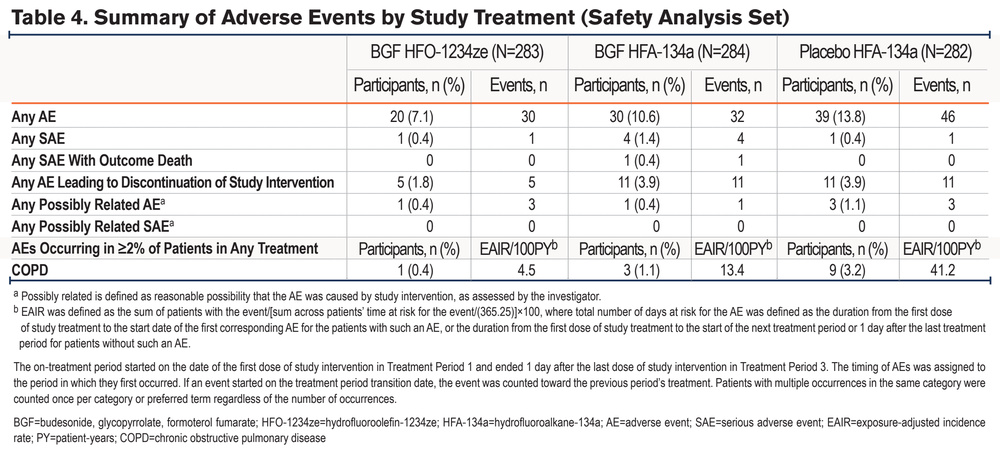
No serious cardiovascular events were reported with BGF HFO-1234ze, and no bronchospasm events occurred in any treatment period. There was no signal for cough, dysphonia, or other AEs plausibly related to propellant transition among participants receiving BGF HFO-1234ze. One participant died during the BGF HFA-134a treatment period, but the cause of death was unknown and assessed by the investigator as unrelated to study treatment. No other clinically significant AEs and no clinically meaningful changes in vital signs were observed. Use of SABA rescue medication was generally similar between BGF HFO-1234ze and BGF HFA-134a.
Discussion
Triple therapy with an ICS/LAMA/LABA combination is an effective treatment strategy for patients with moderate-to-severe COPD whose symptoms are inadequately controlled with single or dual maintenance therapy, as outlined by the GOLD committee recommendations.6 In this randomized, 3-way crossover study, the ICS/LAMA/LABA combination BGF (320/18/9.6 μg) demonstrated pharmacodynamic equivalence with respect to lung function improvement when delivered via pMDI using the next-generation low-GWP propellant HFO-1234ze compared with the established HFA-134a formulation in patients with COPD. Both changes from baseline in FEV1 AUC0-4h and trough FEV1 at Day 29 were pharmacodynamically equivalent between formulations, and the superiority of BGF HFA-134a over placebo HFA‑134a for these endpoints confirmed adequate assay sensitivity. In addition, time to onset of action (effect on lung function) was similar for both formulations of BGF. Collectively, these findings indicate that lung function improvements achieved with BGF are equivalent with HFA-134a and HFO-1234ze.
Safety profiles were comparable between the 2 BGF formulations. The overall safety profile of BGF HFO-1234ze was consistent with the known safety profile of the BGF pMDI containing HFA-134a, which is approved for COPD maintenance therapy.19 During the 1-month treatment period, the frequency of discontinuations was similar for BGF HFO‑1234ze and BGF HFA-134a, and no safety signals consistent with propellant-related effects, such as bronchospasm, cough, or dysphonia, were observed. These findings align with results from the recent Phase 3 safety study assessing BGF HFO-1234ze in patients with COPD.14
Overall, this study supports the established benefit–risk profile of BGF and provides evidence that reformulating BGF pMDIs with HFO-1234ze maintains pharmacodynamic performance and safety while offering a substantially reduced environmental impact compared with HFA-134a. This study completes a broader clinical program evaluating the effects of propellant transition on pharmacokinetic and pharmacodynamic properties of BGF and supports transitioning from BGF HFA-134a to BGF HFO-1234ze. Prior studies have demonstrated pharmacokinetic bioequivalence between BGF HFA-134a to BGF HFO-1234ze in healthy adults and shown a comparable safety profile in patients with COPD.13,14
A personalized approach to inhaler selection is recommended to optimize device use, adherence, and disease control.20,21 Moreover, patients often prefer inhaler devices with which they are already familiar,21 and maintaining device continuity can be important for sustaining disease stability.22 Switching from pMDIs to DPIs for nonclinical reasons may negatively affect respiratory health status.20,23,24 Therefore, transitioning from the BGF HFA-134a formulation to the lower-GWP HFO-1234ze formulation enables patients to continue using a familiar pMDI platform while reducing environmental impact.25
This study has several strengths, including its global scope with broad participant representation, a crossover design that allowed each participant to contribute to each treatment comparison, and the incorporation of design elements intended to minimize participant burden, such as active medication washout periods that minimized time on placebo and reduced overall study duration.
The study also has limitations. This study enrolled only current or former cigarette smokers with a smoking history of at least 10 pack years, consistent with the study eligibility criteria. Although commonly used in COPD clinical trials, this criterion may limit the generalizability of these findings to individuals with COPD related to other inhalational exposures or with less extensive smoking histories who are increasingly encountered in routine clinical practice. In addition, as the study was designed to assess pharmacodynamic equivalence, it did not evaluate clinical outcomes such as exacerbation reduction, although improvements in FEV₁ are highly correlated with clinical efficacy in COPD, and other clinical outcomes are very likely to be similar given that pharmacokinetic bioequivalence has been previously demonstrated.13,26
Conclusions
This study demonstrated that lung function improvement with BGF formulated with HFO‑1234ze is equivalent to that achieved with BGF formulated with HFA-134a in participants with COPD. The safety profiles of the 2 formulations were also comparable, confirming the established positive benefit–risk profile of BGF and supporting the transition from HFA-134a to HFO-1234ze in BGF pMDIs. Together, these findings provide additional support for adoption and use of HFO-1234ze in clinical practice given its >99.9% lower GWP and demonstrated equivalence to current treatment options for COPD.
Acknowledgments
Author contributions: AB, YT, DP, PB, JM, MPa, and MKH were responsible for conceptualization of the study. MC, AB and YT were responsible for data curation. MC, HP, YT, MPu, DP, JM, LP and MPa provided formal analysis. Funding acquisition was provided by PB and MPa. MC, MJ, AB, YT, LP and MPa were responsible for study investigation. MC, AB, YT, MPu, DP, JM, LP and MPa were responsible for the study’s methodology. Project administration was provided by MC, AB, PB, A M-P, LP and MPa. MC, DP, PB, A M-P, LP, and MPa were responsible for study resources. Supervision was provided by MC, HP, AB, PB and A M-P. Validation was provided by MC, YT, JM and MPa. Visualization was provided by MC, YT and MPa. Writing, review, and editing of the manuscript was provided by MC, HP, MJ, AB, YT, PB, A M-P, LP, MPa and MKH. All authors reviewed and approved the manuscript submitted for publication.
Data sharing statement: Data underlying the findings described in this manuscript may be obtained in accordance with AstraZeneca’s data sharing policy described at https://astrazenecagrouptrials.pharmacm.com/ST/Submission/Disclosure. Data for studies directly listed on Vivli can be requested through Vivli at www.vivli.org. Data for studies not listed on Vivli could be requested through Vivli at https://vivli.org/members/enquiries-about-studies-not-listed-on-the-vivli-platform. The AstraZeneca Vivli member page is also available outlining further details: https://vivli.org/ourmember/astrazeneca/.
Other acknowledgements: The authors would like to thank the study investigators, study participants, and Tomasz Lebitko, Meng Li, and Sampath Madanu, AstraZeneca, for statistical programming. Medical writing support, under the guidance of the authors, was provided by Kirsty Ainscough, PhD, and Stephanie Dubrof, PhD, employees of Omnicom Health Medical Communications and was funded by AstraZeneca, in accordance with Good Publication Practice (GPP 2022) guidelines.27
Declaration of Interests
MC, HP, MJ, AB, YT, MPu, DP, PB, AM-P, JM, LP, and MPa are employees of AstraZeneca and may hold stock and/or stock options in the company. MKH reports personal fees from Aerogen, Altesa Biopharma, Amgen, AstraZeneca, Boehringer Ingelheim, Bristol Myers Squibb, Cipla, Chiesi, DevPro, GlaxoSmithKline, Integrity, MDBriefcase, Medscape, Merck, Mylan, NACE, Novartis, Owkin, Polarian, Pulmonx, Regeneron, Roche, Sanofi, Teva, UpToDate, Verona, and Zymeworks. She has received either in-kind research support or funds paid to her institution from the American Lung Association, AstraZeneca, Biodesix, Boehringer Ingelheim, the COPD Foundation, Galvanize Therapeutics, the National Institutes of Health, Novartis, Nuvaira, Sanofi, and Sunovion. She has participated in data safety monitoring boards for Medtronic and Novartis with funds paid to her institution and has received stock options from Altesa Biopharma and Meissa Vaccines.